Thursday, 20 September 2018

A call for submissions


If you are interested in contributing to this archive of art therapy objects please email me – Dave Edwards – at daveedwards54@gmail.com

Please note: To be included in the archive all submissions must follow the specified brief:

1. The submission of a photograph or scanned drawing - of sufficiently high quality - of an object - made, found, gifted, purchased or which has in some other way - has played a significant role in their professional life.

2. A brief description of the reasons for choosing this object.

3. Brief biographical details.


Wednesday, 19 September 2018

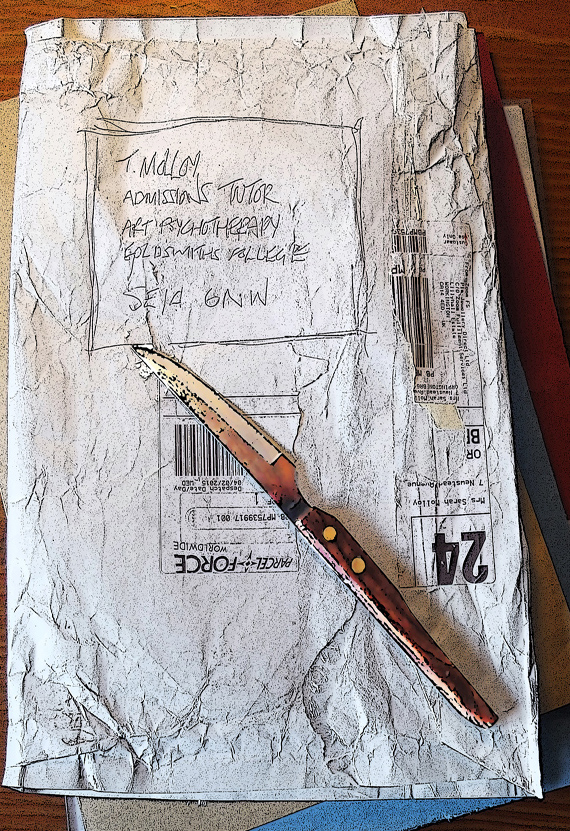
The knife


The knife comes from a time when the Art Psychotherapy Department at Goldsmiths College was situated in a tall Georgian house near the main campus buildings. A small room at the back of the house had been converted into a makeshift kitchen with a door opening onto a pleasant garden area. The door was left open during summer months, which created a rather cozy, comforting domestic atmosphere; it also provided a route to an open space where some staff members could enjoy a much needed cigarette! The kitchen often became the site of many interesting discussions, perhaps enabled by being away from the stresses and professional discipline of the teaching rooms and studios. The kitchen was mainly used to prepare tea and coffee in the short breaks between teaching sessions and meetings. Sometimes it was also used to store, prepare and serve food for end of year parties and occasionally, the impromptu picnics that sometimes surrounded the firing and opening of the raku kiln built in the garden. All this led to the accumulation of a motley collection of cutlery and crockery in the kitchen unit drawer, the knife in the image being one of these items.

 When I took on the role of admissions tutor the knife somehow migrated to my office and became a paper knife to open the increasing mountain of mail that then came my way. There it remained until I retired from the college. Its second and final migration was to my desk at home. I took it without asking - who would I have asked? I think I just wanted, as well as the usual retirement gifts and cards, a very ordinary everyday souvenir of all those years.

The knife itself is somewhat unremarkable. A friend recently suggested that it looks rather like a steak knife of 70’s Berni Inn style. A rich host of vintage connections there- at least for people of my vintage! The hardwood handle and brass rivets have stood the test of time well and have acquired that smooth, comfortable patina that comes with constant handling. The blade, once sharp has moved on from being capable of inflicting an accidental cut, although the point could still be a potential hazard. I haven’t tried to sharpen it; I like it just the way it is. On one side of the blade is the inscription ‘Argyll Stainless Steel’. On the other side is stamped ‘Foreign”. These two terms seem contradictory, although in these days of possible UK reconfiguration, perhaps apt.

I think the knife has found a good home. As well as still using it for opening post, I often reach out for it for purposes such as scraping of scratching through a thick layer of oil pastel, or for cutting through a folded sheet of drawing paper to make smaller pieces; its softened serrations leave a nice fluffy edge as opposed to the very precise one which a sharp blade would make. It puts me in mind of things beyond the purely professional aspects of Art Psychotherapy; the friendships, support, shared beliefs and ideals of like-minded colleagues.

Terry Molloy was employed in the field of art therapy for over forty years, and taught on the Art Psychotherapy training course for over twenty years, before retiring to develop his personal art practice. He was involved in the British Association of Art Therapists (BAAT) since its early days, was a BAAT Council Member for several years and Vice-Chair for two. His practice as an art psychotherapist included work with adolescents in special education, adults with learning disabilities and with adults in private practice as well as in secure, acute and long-term psychiatry.

A Handbag?!


In 2013 I was given my grandmother’s handbag. 

It summoned her to me, opening a cache of memories of childhood visits to her dusty flat in Barcelona. As a child I never questioned why my family was spit between England and Spain, and I grew up with a second home blissfully located on the beaches, streets and squares of Barcelona. 

I lost contact with my Spanish roots when my grandparents came to live with us in Birmingham, back in 1975, shortly before the death of the dictator - General Francisco Franco. I had lived my Spanish idyl in the last decade of the Franco regime with a strange atmosphere - which I now know was infused with an unspoken traumatic memory of the Spanish Civil War, and my father’s rupture from family and homeland. 

My encounter with the handbag was almost overwhelming. It seemed to embody my grandmother’s presence which at first was a joyful reunion, but the shadow of the Spanish conflict soon caught up with me as I uncovered a painful family history. 

My father suffered with a serious clinical depression for most of his adult life - a condition managed with pills and electric shock treatments. He was never offered a talking therapy and this was another unspoken history (of mental illness ) but the anxiety he lived with was evident. I believe that children receive and inherit hidden trauma and often blame themselves for their parents’ unhappiness. 

I loved my dad, and although I didn’t understand his struggle I wanted to make things better. Looking back I was probably drawn to art therapy by a need to heal my family history and the way it had played out for all of us. I felt that the not talking was a kind of prison. 

I trained as an art therapist in Sheffield in 1986 - 1987, and developed a tentative painting practice through the experiential group work sessions on offer. This early training set me on my way, and forms the backbone of my current professional practice. I now work as an artist and mentor to other artists, I also run community group work sessions. I no longer work as a therapist, strictly speaking, though in a broad sense my art therapy training informs everything I do - even the research for my projects. 

I mainly use objects as my inspiration for the many branches of my work, but inheriting my grandmother’s handbag seemed to open a portal to the past. 

Between 1975 - 2013, it had taken up residence in my mother’s wardrobe high up on a shelf, and was used to store old currencies and cancelled passports. So much had happened in my life - too much to detail here - while the handbag waited for me. Or so it now seems. 

The accompanying poem came to me during a series of broken nights in which I dreamt vividly of reconnecting with my past. I felt my grandmother was guiding me, almost speaking to me though the handbag. 

This prompted me to create my overarching, Barcelona in a Bag, project which is ongoing. Through it I seek to create a body of work which responds to the Spanish Civil War, and digital iterations of my work can now be found at Tate Britain, BBC Radio 4 and the Bodliean Library, among others.

Barcelona in a Bag

Sitting on mother’s shelf
housing the euros and the francs
and the cancelled passports
it sat emitting messages.

My time was then but it is also now.
Come, claim your histories, your map!

Too heavy then for grandma’s arm
bought with vigour by your hands, now frail
Unknowing how weighty it would be.
A real handbag! you thought. 

But it smarted in her hand
and finally the bag came to me.

Now abuzz with interference, (a large radio-player)
a boom-box with a heartbeat
the handling so right
nestling under my arm

My smooth-haired dachshund of a bag.
The longed for remembering’s yap
that summons thirteen years of summer

Now is the time to draw on her.
(What innards!) And her pale lining unfurls 
a recipe for cinnamon sand. 

It runs through your fingers
the sweet smell lingers
it’s time for cinnamon sand!

It’s a flan of a bag.
My crema Catalana to your creme brûlée.
On a maritime stroll her buckle winks and flashes
morse code.

I am the baton, I am the beat
and the fuzz of time is nothing to me.

Sonia Boué studied Art History at Sussex University, and qualified as an Art Therapist at Sheffield University. Sonia is a multiform artist who works with themes of exile and displacement. Recent work includes the BBC Radio 4 programme The Art of Now: Return to Catalonia, which focused on inherited traumatic memory. In 2016 Sonia discovered she was autistic and her new project is the Arts Council funded, Museum for Object Research, which includes a professional development initiative for autistic project leadership.


Secrets, symbols, cornucopias, prophesies?


The four boxes are a small selection from my ‘collection’ of containers that I provide my private practice clients and clinical supervisees for safe storage of their three-dimensional artworks. I have collected these and other boxes over many years, seemingly randomly, though have begun to question how random this really is/they really are over the last few years. Some are given to me, some I have procured from elsewhere or simply found, some I have actively solicited from colleagues, friends and neighbours when my supply is diminished. I never really know what I am going to put into and have in my store at any given time and have never paid much conscious attention to them other than perhaps their size, shape, structure and satisfactory condition. Farrell-Kirk (2001) notes that boxes are widely accepted as an art therapy technique and she explores how boxes are employed by clients to this end. What I have found in recent years that has stimulated my interest and afforded delightful intrigue is how surprisingly well the appearance, nature, context - ‘brand’ - of the box arriving in my therapy room to be allocated a specific client seems to speak of what is central to what any given client is bringing to art psychotherapy – most often long before such material has emerged consciously or become apparent otherwise. I have been given to flights of fancy that the boxes are dialoguing with me at unconscious depths, mischievously inviting that they know more than I or my clients do, enticing me to select certain ones ‘pick me, pick ME!’. Some may argue this is merely my projection, and with 27 years of clinical practice experience I can ‘attune to’ what is in the depths of a client’s psyche and soma on first encounter. While I will have conducted an initial assessment and built a little image of my client prior to commencing art psychotherapy, that seems a fundamentally pompous, hubristic notion to me. I just don’t buy that. I can’t - despite being an ardent advocate for synchronicity. I imagine the boxes choose the client. I find myself ‘staying with the box’s communication’ as it were, to take this precious communicator, frequently prophetic object of affinity with its client, confidently clutched in hand from the attic store - a box that inevitably ‘belongs’ to the commencing client. The boxes that chose to be included as a photo for others to view told us (client and me together) of core states, experiences, defences, lacks, paradigms, beliefs, anguish, physical illness and much more. A container, a holder? Yes, inevitably, what else then. A repository, receptacle, chest, hamper, casket, coffer, bin, protector of secrets and symbols, and now?...A remarkable cornucopia of prophetic conveyances adding to the mysterious alchemy of unfoldingnesses of matters of great import at another unknowable level during art psychotherapy – evidently an additional previously-unforeseen ‘foreseer image’…Am I still intrigued by this new exegesis of ‘self-box’? You bet!

Shelagh Cornish has been in continual practice with children, adolescent, parents, families, and adults in inpatient, outpatient and the community, presenting mental illness diagnoses amongst other troubles for more than 27 years. Previously Lead Art Psychotherapist in Specialist Child and Adolescent Mental Health Services, and Strategic Lead for the profession in Derbyshire Health Care Foundation NHS Trust until 2012, she is currently a Senior Lecturer and researcher on MA Art Therapy University of Derby (since 2002), Senior Lecturer Nottingham Business School Nottingham Trent University, BAAT Registered Clinical Supervisor, BAAT Registered Private Practitioner, HCPC Registered Art Psychotherapist, Registered Member MBACP, Member of BAAT SIPP-SIG, Member of ATCAF -SIG, a Systemic Practitioner and practising artist/musician. Further information can be found at www.heartening.co.uk 

“The girl with no eyes is looking at me…” - It’s a Beautiful Day, 1969


This sculpture used to be based in the art therapy room at the old Mickelover site where the
art therapy programme in Derby was delivered. I am not sure who made her however she
used to prop the clock up in the room where the experiential groups were facilitated. When I
took on my role at the University 14 years ago she would be silently sitting in the space
literally holding time. She got little attention then as she was partly lost in the many other
objects within the space acting primarily as an elaborate means of holding a clock when a nail
would suffice. When we came to move sites after the sad closure of that campus I found her
sitting on top of a pile of objects thrown in a cupboard heading to a skip. Without much
thought I retrieved her and took her to the new campus. For many years after the move she
continued in her role providing a sense of continuity during many annual room changes. Once
the art therapy group found a more permanent home, due to the room needing to be ‘neutral’
she was required to live in a cupboard with the paper store and as such would get rolled out
to be present during the group assisting in delineating the space. Eventually I was able to
attach the clock to the wall and as such she lost her primary function in holding time and then
took on a new role of holding and containing the tissues within the group. This is how she
currently remains. As I am in the process of stepping down as Programme Leader for the MA
in Art Therapy and exploring leaving the University I am unsure about her future. She has
overseen the training of nearly all of the graduates from the Derby art therapy training since
2002. Only in the last few years where groups have been divided has she not had the privilege
to witness all of the trainee’s engagement with the demands of their training. I suspect when
I eventually leave she might accompany me however that is something that we are currently
discussing.

Nick Stein is a practicing art psychotherapist, musician and artist. He is particularly interested in dream imagery, the psychotherapy of cumulative trauma and the ideas of an archetypal psychology. Since 2004 he has been the programme leader for the MA in Art Therapy offered by the University of Derby and before that was working within Forensic Psychiatry. 


The smartphone


My own art-making is large and messy. I have a preference for using my hands and working with pastels and charcoal on a large surface or building 3D paper structures. So, the idea of using an iPad or smartphone for art (and art therapy) seemed instinctively gimmicky and restrictive. However, my views have been challenged by my clients (people living with terminal illnesses) who use iPads, tablet computers and their smartphones to maintain their creativity and social connections; and by those artists who incorporate iPads into their practise (eg David Hockney and Amy Silman). I have become fascinated by the changes in interpersonal relationships, and individuals’ self-perceptions that result from our attachments to these portable handheld digital devices.  

This object - the smartphone - is small and tidy. Yet its presence in art therapy opens up a large and messy arena, disrupting the therapeutic frame, pulling on issues of personal agency, connectivity and isolation, self-representation, making memories, and everlasting legacy.

Michele Wood: Since qualifying in 1987, Michele has worked consistently as a practitioner, educator and clinical supervisor. She is currently employed by the University of Roehampton and the Marie Curie Hospice in Hampstead. Michele is an international authority on art therapy in palliative care, and has research interests in the use of digital technology in art therapy. 

Ode to the Hot Glue Gun


Yes, it is a bit dangerous! Hot glue is like melted cheese, it is burning hot and sticky. So be careful.
The benefits outweigh the risks. The glue is grabby, except on dusty stones and suchlike. It holds: it makes do with bad joints, or almost no joint at all.

It is blobby, when needed, welding bits together which would never stay otherwise.

It is quick too. Nice. Quick, like right now! It sticks and things are stuck. Clamping? Rarely. Waiting ‘til next week for the next stage. No! Pinning balsa wood; no.

Kids are impatient; creativity is impatient; I am impatient. Glue guns meet the need for speed: for action and results.

Hot glue is stronger than you might think too. Can you make big stuff? Yes, you can:

Parents aren’t always so keen on the glue gun. With energetic youngsters and enthusiastic art therapists in cahoots is there any limit to the stuff that can be churned out with remarkable rapidity and surprising size? Well…….

Limited only by available materials and the size of a: doors, b: the car to take it home in, and c: where on earth are we going to put all this stuff?

I love cardboard, glue guns love cardboard. Hospitals usually have quite a lot of cardboard lying about too. Plentiful and cheap. Raid the big recycling bin outside.

Want to make a beautiful big giraffe? Armature glued together in minutes, belly from card glued into place and Modroc sculpting underway in no time at all. Strong and striking.

Viking longboat? Model theatre with working trap door? Wooden racing cars? Barcelona Football Stadium? Miniature fish tank with model magic starfish, octopus and seaweed….a house on stilts? Stick shells on things… stick things on things.

Using those art straws that have been around for a decade in the cupboard, finally.
How did I manage before?

PVA, balsa glue, a staple gun, hammer and panel pins, masking tape, and even solvent free Bostik (is it even still a glue?) It is true that these methods provided opportunities for frustration, anger, fury, disappointment, and, at best, patience and ingenuity in ways now avoidable. And that was just me. The creative process usually brings opportunities for those experiences in any case. But with the hot glue gun there is a chance to realise a client’s imaginative vision more vividly, to push boundaries of what the materials will do, sometimes to fail better, but to create bigger and better too.

Michael Atkins trained in Sheffield (Claremont Crescent), graduated 1998 and worked in Child and Adolescent Mental Health Services (CAMHS) in the NHS from then on, more or less, until August 2015. Now no longer registered, no longer employed, no longer a member of British Association of Art Therapists. Still creative, still playing, still have sense of humour, and looking forward to the future.


Photo-Art-Therapy


This is my most treasured camera, that I spent many years carrying and using. This
camera, along with an Olympus Trip and an old enlarger, were the tools the young people
used to undertake therapeutic photography with me, in a therapeutic community. This
activity provided the nudge to train as an Art Therapist.

As a child I had used the Canon's predecessor, a Russian Zenith B, to create constructed
images on cheap Eastern European slide film. I was amazed at how unquestioningly
adults would accept photographs as being 'OF' something 'REAL'. For me, with poor
eyesight, the photographs I took mediated the only way I ever saw a world both sharp and
made up of straight lines. Before photography I had a choice of 2 worlds, a blurred one or
one barrel distorted by strong spectacle lenses.

I worked for a time in that therapeutic community, using therapeutic photography, in
camera and darkroom, with adolescents to explore their world with them. The strength of
staff and residents' responses to these images, and to other art making, led me to apply to
train as an Art Therapist. The curator of this exhibition interviewed me and was surprised
to be presented with a portfolio of photographs. I funded myself to train by resuming
working as a freelance photographer during my training.

While training and in my first job after qualifying, I participated in family therapy and
realised the importance of images in the narratives we construct around our histories.
Photo-Art-Therapy has been a thread woven into my practice throughout. Initially
manipulating Polaroid images, photocopies, and creating collages with scissors and glue
were the primary photographic contributions. More recently digital devices from Nintendo
DSi to smart-phones have created any photographic dimensions of art psychotherapy
practice. Very few clients use photography and then only occasionally in sessions, but
often make images between sessions that will serve as catalysts to process in the hour in
the art therapy room.

The space in the art room may be filled with messy poster paint, glue, balsa wood, chalk
and oil pastels, but the visual lives of many people now are dominated by tiny screens.
The opportunity to expand beyond the phone-frame is rare. For many, there is a struggle
to contain such unstructured and unlimiting space, which we, as Art Psychotherapists can
offer. A century after the invention of the Kodak Brownie, the democratisation of smartphone
photography and online galleries may further inhibit people from depth of
engagement with images.

Now the Art Therapist has an extra dimension to their practice when words are not
enough.

Mark Wheeler has been an Art Therapist for over 25 years, working in Child & Family Therapy NHS (CAMHS) and a small private practice. Mark undertakes direct work with individuals, families and groups, as well as offering clinical supervision to many mental health professions. Mark engages people in conversations about and with their images. These may include drawings, paintings, sculptures as well as family photographs. Mark also facilitates workshops and training events. Mark arrived in the arts therapies via photography, becoming interested in the psychological dimensions of making and viewing images.

My Mother’s Paint Box


Rolled round my tongue from early years, these words;
Prussian, Gamboge, Vermillion
Ultramarine from over the seas.
You smiled at my talk of Yellow Ogres 
Stalking across the Burnt Sienna, 
Told me tales of mango-leaf fed cows,
enslaved to the colour Yellow.
In powdery Cobalt I painted a bridge 
Re-stirring that lurch of our Austin 7 down the Lichfield Road
With its alchemic mix of excitement and fear.
You named the serious poison mined for that jewel shade
Payne’s Grey was your favourite,
For misty, mutable light, rain and melting clouds, 
But when black was vital 
We mixed the primaries
To a host of relative darks.

My mother, Vera, an art teacher and keen amateur painter, died in 1986 just prior to my beginning on the Sheffield Art Therapy training programme. She always encouraged my painting, drawing and interest in the history of art, and her interest in arts and wellbeing was formative in my life. 

I inherited her travelling paint box which reminds me of her encouragement to always be ready to make art.

Laura Richardson was born in Walsall in the West Midlands, and studied English and American Literature at the University of East Anglia. Following a period of working in a collective and as a volunteer counsellor in Oxford she came to Sheffield to study art therapy in 1987. She also holds a BA in Fine Art, and an MA in art psychotherapy research. She has worked in Sheffield in the voluntary sector with children and families, in the Social Services mental health day service, and for 26 years in the NHS mental health service before retiring in December 2017


Oscar's Picture


Oscar, my five year old son, made this drawing when he was four. He came home, handed me the drawing. “It’s a gift for you”. I asked him what it was, “It’s a monster” Later he said “That picture is me” recently he said it was his Daddy. Next week, who knows where he'll go with it.

I trained on the Art Psychotherapy MA at Goldsmith's University in London primarily to work with children and families. This has been a great foundation for the work I have been doing however the birth of my son and our subsequent relationship has profoundly affected my practice.

Not only has being a parent given me a live experience of child development but also and more importantly a better understanding of my own attachment relationships. As I observe Oscar's relationships with my parents I am reminded of the triangular relationship between client, image and therapist. This is integral to Art Psychotherapy. As art is a way of recognising oneself I no longer recognise the person I was before Oscar.

The love a parent feels for their child, the love we feel for our siblings, family, friends, lifelong partner, lover and self all relates to art psychotherapy. And art psychotherapy at its best and gives room for love to be present. In a letter to fellow psychoanalyst Carl Jung, Freud wrote that “Psychoanalysis is, in essence, a cure through love” (1906).

Katya Somer qualified as an Art Therapist in 2008 from Goldsmiths College, London. Having moved to Sheffield in 2012, Katya currently works as an Art Therapist at Bradford District Pupil Referral Unit where she works with 13-16 year olds excluded from mainstream education and as a Mental Health Practitioner in the Child and Adolescent Mental health Service in Rotherham. Alongside this work, she is an associate with the charity Art Therapy Yorkshire, offers sessional work in schools and has a small private practice.


My paint pallet


Don't be an art critic. Paint. There lies salvation. Paul Cezanne

Back in the 1980s as an art student studying illustration I discovered Cornelissens & Sons in Charing Cross Road and on entering the emporium found myself surrounded by colour. I was mesmerised.

I bought my first watercolour set for some heady price and on opening it for the first time felt as if I had released the inspiration to paint. The colours struck me, like the first time someone says you are beautiful. I can’t really explain what it felt like when I opened the pallet for the first time or do the experience justice; it was so visceral like finding the most precious gem in the world and wanting to keep it all for myself. I wanted poured over the colours with my eyes drinking in the hues with a hunger for colour in my life. 

In short, this was the most beautiful object I had ever seen and yet not. It took me back to a time in my childhood when I was given a big set of multi-coloured crayons. I couldn’t believe there were so many colours in the world, and the possibilities of making art opened up to me. But it wasn’t so much about using them as possessing them. Like the watercolour pallet the crayons represented hope and as Cezanne says, salvation. It was like finding the love of my life and I desired them, doted over them, I fell in love with the small shining jewels of colour and what was even better were the little packages they came in. Unwrapping them was like every birthday surprise I’d ever wanted. The possibilities were endless and I knew I had found the route to my creativity. I couldn’t go wrong with my watercolours and every time I used them I fell in love all over again. The colours luminesced, swam together making new colours, flowed on the paper with a magic that excited me as if they painted themselves. It was simultaneously organismic and pure, like the birth of a baby. 

The photo is of my second pallet from the same suppliers and a treat to myself when I had earned enough money through my private work as an art therapist. On receiving them I had exactly the same experience as I had originally and delighted in opening each individual little package. Before me was revealed the same intense beauty and desire. I was captured by the same powerful emotions and feelings that I owned the most precious gift in the world. The pleasure of these colours is immense for me and I wanted to share them with others in the hope they too would have the same experience as I. 

You can see they have been well used, but not by me. As my gift to my patients I have overcome my inner art critic who wants them to be taken care off and loved as I love them.

Kate Rothwell is an art psychotherapist working in private practise, the NHS and prison service. 


29 years lean


29 years lean,
A diary page for all lives seen.
For each expression, depression, Condescension and rage
hands raised in anger… every day  caged
mark that time,  story, act and mime
moment to  movement I don’t draw lines.
Defy hollow words that cheapen interaction
viscous vowels give me no traction…
I’m an artist, show me and I will feel it
share anger,  pain(t) with your fears
fixed in the fibres by my tears
... a record for each memory displaced,
innocence, pride and ambitions disgraced,
anger and rage, consequence of age
Each moment of ire
Of unrequited desire.
Watching what has gone before
the shadowing role which I abhor,
it’s enough to match my breathing in those dark places
to know what I know and see what I see
I’m here, I’m me... and not  judge.
With each breath, each ragged intake, tongue slake, heart ache… Each no way out.
Pencil loads memory into the cartridge and with each trigger…each release,
a  pencils report, ecstasy and pain simultaneously wrought.
Each page etched in letters of your name
(on that institutionalised grave stone and in the long shadows on my face) ,
At this time, for this long and in this place.

Karl Tamminen has worked in the NHS for 29 years, 26 of them as an Art Therapist in low , medium and high secure mental health services. Currently his working week is split between the dual roles of clinical specialist in forensic art therapy and as the trust wide Professional Lead for Arts Therapies in the Humber NHS teaching Trust.

Faces and Scarves


When Dave asked me to be involved in this exhibition (despite not being an Art Therapist myself but being very involved in the world of Art Therapy both personally and professionally over the last 30 + years) I immediately knew the object I wanted to choose.... if only I still had it!!

It was an image I had made while supporting Dave in running an Art Therapy group in a Regional Secure Unit. Dave was the visiting Art Therapist and I was an Occupational Therapist working in the unit. This was also before we became a couple. Although I was the unit staff member Dave encouraged me to use the art materials alongside the group members. It was my first real understanding of Art Therapy and how the group members responded to the process.

Of course I did wonder what my image was about. I remember enjoying using good quality art materials and having fun with the colours and shapes. ‘Faces and Scarves’ was what I informally called it. I valued and liked my image enough to keep it and for a while it was even framed and on the wall in our home in the late 80's. But over the many years since then I believed it to be lost.

I shared my idea of what I would have chosen with Dave and you can imagine my delight when he searched through some old folders of art work and found it!

Just looking at it again made me smile and remember.

Now I think it symbolises the start of my relationship with Art Therapy in so many ways and represents the many connections with Art Therapists and Art Therapy over the years, some very good and some challenging, both inside and out of work.

So for me it is a very personal Art Therapy object

Julie Edwards (formerly Leeson) trained as an Occupational Therapist and started working in the NHS in 1981 and has mainly worked in and around mental health ever since. Julie first encountered Art Therapy in 1982 at Stanley Royd Hospital in Wakefield and since then has had a long standing relationship with the discipline, as both a colleague and a manager. On a personal note, she is married to an Art Therapist!

Pinhole camera


As a kid I spent much of my time inventing props and images for my fantasy life. To fully imagine I wanted to make it live outside my skin via the play between my eyes and hands. I modelled my imaginings with plasticise and drew them with coloured pencils, I would look at things, people and places then shut my eyes to remember them like a camera; sea and river, trees, ships, boats, cars, aeroplanes, footballers, teeming insect life, animals and birds. Fantasizing before falling asleep I would call out to my father to verify crucial facts, which was faster, Spitfire or Hurricane, lion or tiger, or who scored the most goals or runs? This was in my Western Australian childhood living near the bush on the edge of an isolated tuberculosis sanatorium inland from Perth where Dad was Medical Superintendent. He was a specialist in tuberculosis and one of those who helped eradicate it as an epidemic disease.

Later we moved to Fremantle then Perth and when I was ten I made a pinhole camera out of a cardboard shoebox, pinhole at one end and painted white screen at the other because I wanted it to be like the ‘pictures’. I made little seats for the audience and a viewing window in the roof of my make believe cinema, sometimes I pointed the pinhole out of Dad’s car window and watched the upside down world pass by.

My home made camera strikes me now because it seems a stand-in for myself, of the theatre inside my skull and of who I became, an artist who worked in hospitals to earn a living in a way helpful to patients and later to train others to do likewise. Key to this was the artist Guy Grey-Smith who caught TB in a German POW camp during World War II and then as a patient in England was helped by Adrian Hill who originated the term ‘art therapy’ to describe his method of working with TB patients. Suffering a relapse after returning home to WA he met my father and became a family friend who introduced me to art therapy after I finished art school.

Arriving in Britain in the early 1960s I worked in psychiatric hospitals and became intrigued by the experiences of the patients I met. What goes on behind another’s face is hidden to others and often obscure for those whose face it is. A ‘complicated pancake’ the Irish writer Flann O’Brien wrote. Sometimes this inner self has to be ‘seen to be believed’. A camera became essential to store the art work of many years in art therapy studios which, if spread out flat, might literally cover acres of space. Some of these paintings, drawings and sculptures were as baffling as O’Brien’s pancakes.

I recalled my childhood device years ago in an art therapy workshop and made a drawing of it which is now lost. So my photographed drawing here is a drawing of a drawing and a memory of a memory.

John Henzell: I was born in 1938 in Manchester where my mother was from, my father was Australian. In 1941 my mother two older sisters and I moved to Western Australia followed later by my father who had served as a ship’s surgeon in the merchant navy. I received my schooling in WA followed by art college before going back to Britain in 1959 to work as an art therapist in the NHS. I returned to Australia in 2001 then again to Britain in 2017. Underlying all these years was a playing off of what I saw outside my skin against what I saw behind it, no mere abstract construct but a picture album that became myself which I sometimes try to describe to or search for in others.


Overall mark ...


This is a particular Assessment Report, which finalised my 1st year Live Art Work option, whilst I was attending the Contemporary Fine Art Degree at Sheffield Hallam University, Psalter Lane Campus, in 2006.  

On discovering and re-reading the Assessment Report some 12 years later, I have come to realise the significant role it has played in both my personal and professional journey.

Both the degree course and the live art option lecturer, Hester Reeve arrived at a time in my life where I had found that I could begin to express some of the internalised frustrations, which had built up inside me during my years of employed service within the NHS and eventually a dissolved marriage.  It was at this point in my life where I began to reclaim and re-engage with the art process.

It was through the support of Hester, where I continued to produce artwork, through expressing my internalised feelings.  This way of producing art became a natural cathartic process that ultimately led me to a therapeutic process.

The ‘Body in Trouble’ Live Art project which is also mentioned in this Assessment Report, allowed me to play and explore change.  It is now, some 12 years later where I once again find myself exploring change.  Since qualify as an Art Therapist and subsequently as a teacher, I have now reached a point in my life where I have gained a professional duality and ultimately I am faced with having my feet in 2 professional camps, which should be a positive position for me.  However, since both the mental health and educational services have experienced much change and funding cuts, job vacancies specifically for art therapists in education have dwindle.  Therefore, I construct my ‘Overall mark…’ once again by unearthing my strength and confidence to continue to practice in this adaptive profession as an Art Therapist.

Joanne Casey-Castley trained as an art therapist at The Northern Programme, Sheffield/Leeds Beckett University.  Completed in 2015 and graduated in 2016.  Has since qualified as a teacher and is applying her therapeutic approach to her work with both adults and young people.


Golden Boxing Gloves


“Time is the substance I am made of. Time is a river which sweeps me along, but I am the river; it is a tiger which destroys me, but I am the tiger; it is a fire which consumes me, but I am the fire.”   -  Jorge Luis Borges

Post-partum was an interesting period of time.  The depths of feelings explored while pregnant and the subsequent responsibilities brought with a neonate were beyond my expectations and imaginings.  Within a few short months, new titles adhered themselves to my being, mother; carer; provider; protector; nurse; parent and other titles stuck or took on new meaning, woman, daughter, professional, partner, wife.  These words imbued with connotations and expectations filled me with a great sense of delight and an awful sense of dread.  What does it mean to be ‘good enough?’  Would I be able to fulfil these roles successfully?

This sculpture emerged during a period of deep reflection and self-evaluation, while embarking on my Master’s degree in Art Psychotherapy.  An unsettling time of reassessing what I believed to be my identity and developing a new and meaningful understanding of my own psyche.  This coincided with becoming a mother to a beautiful baby girl and a change in career path.  Intense personal therapy accompanied many expressions and art creations during this interval.  The Golden Boxing Gloves sculpture felt poignant and allowed me to understand Susanne Langer when she stated “Artistic form is congruent with the dynamic forms of our direct sensuous, mental and emotional life, they are images of feeling which formulate it for our cognition.”  It felt as though Joy Schaverien’s description of an embodied image came to fruition through this piece.  The sculpture illustrated a depth of emotion that was extremely hard to articulate through words. It clarified for me the multifaceted, multi-layered experience of the phenomenological experience.

At the most fundamental level this depiction of a battle worn woman, fighting for the life inside of her and for her life, for the right to motherhood and for a career highlighted the juxtaposition of entitlement and sacrifice.  This for me is what Friedrich Nietzsche called Heroic…

To face simultaneously one’s greatest suffering and one’s highest hope. 

Janet Havemann Bowser: Since qualifying with a Masters in Art Psychotherapy from Derby University, I have mainly worked with children and adolescents with mental health concerns.  I run workshops for schools on the benefits of Art Therapy and a range of topics including Attachment and Self-care.  I facilitate experiential Art Therapy groups and enjoy working with families and the dyadic relationship between parents and their children.  I believe passionately in the potential for art to be a medium of communication.


This image...


This image which hangs on the wall of my consulting room is now 23 years old and starting to show the signs of damage and wear that come from simply enduring time. When it was made on a freshly bought pad of ring bound paper with Chinese inks in 1995 it marked the end of a depression that I had endured following the completion of my training as an Art Psychotherapist in 1994 (a story partly represented in ‘Art Therapy in Private Practice’ (West 2018)).  In marking the end of the depression that has never returned in any comparable way, it also marked the end of a series of nightly paintings made as part of a set. It ended the project that had begun with a commitment to make a drawing before sleeping each night to express my feelings in the moment and provide a concrete example of my creativity and productivity to help lift my mood.

As the image sits on the wall of my consulting room, which is also a living space, it is often commented on by both clients and guests. At the time of its construction, it appeared to me to represent a container or caldron productively bubbling away.  However, to others it has signified a bizarre number of things including; ‘two babies in a pushchair’, ‘two figures having sex’, ‘two adults in a bath in conversation’. It appears to always provoke notions of dialogue and productivity in the viewer (whether sexual, conversational or alchemical) but always active and interactive in some way.

If I run the duration of this image alongside the contemporary history of Art Therapy it has ‘seen’ significant movements in the profession towards greater openness about the therapist’s own vulnerability as the person offering themselves as vehicle of therapy, and also a greater attention to the way images signify openly and can be used as part of creative research strategies.  I am grateful for these developments as this image, as a provocation to imagination and a celebration of the learning that comes in ‘recovery’, ‘speaks’ of the open signification of images that gives art therapy its most therapeutic power.

James D. West qualified as an art psychotherapist in 1994. Since qualifying he has been self-employment and in private practice, working mainly with elders, adolescents, people with learning disabilities or addictions. He is also a clinical supervisor. James is the current coordinator of the British Association of Art Therapists (BAAT) Self Employed, Independent and Private Practice Special Interest Group (SIPPSIG) and was co-founder and coordinator of the BAAT Addictions Special Interest Group (ADDSIG).

The Stencil


I was attracted to working in art therapy as it seemed to inhabit a world of creativity, imagination and play, where expression and spontaneity were valued. An art therapist encourages the notion of having no preconceived ideas: see what emerges, then develop it further, try not to be rational and let the unconscious emerge. For people new to the processes of art, I always introduced a range of art materials. I talked through and showed them how materials might be used in a way that was facilitating and not prescriptive. Making choices of colour, texture, size and form were the first steps. It was tremendously exciting for me, as an art therapist, to follow other people’s personal journeys of self discovery through art. These journeys were often very emotional. Narratives of someone’s life emerged, both by sharing and talking about their art. Through expression and sublimation people were left feeling good about themselves and proud of their art.

However, I later found another world where creativity, experimentation and spontaneity are avoided. Art therapy may then be experienced as unhelpful. This was a world I did not explore for many years. A deeper understanding led me to believe that sometimes, we need to feel in control, so that the status quo of our minds can be maintained and we are not overwhelmed by unwanted thoughts. There are many socially acceptable activities to help us through these times, such as engaging in some sort of repetitive activity like knitting, cleaning and addictive puzzles.

The stencil belongs to this world of control. It would be akin to the factory production line: a mould when using clay, or painting by numbers, none of which are generally associated with the art therapists’ repertoire. I am not referring to the use of stencils to create words or pictures. The intention is to follow the outlines of the letters or shapes, and reproduce these exactly, thus giving the satisfaction of a copy without any deviation. It is a task focussed activity, intended to have no meaning and where psychological interpretation is of no concern.

 I found that sometimes on the journey of therapy, it was important to press the pause button: to adjust the pace to manageable levels. This would result in times when it seemed nothing happened in therapy, and when stencils might be used. I was impatient being alongside someone who did not want to engage in an openness to inner expression and where all thinking was rather matter of fact,  but these were times when control could be experienced and the therapist’s power was challenged. It was difficult for me to silence my therapist’s curiosity and my innate desire to muse over the question “Why?” Only by appreciating the terror of psychosis or the horror of reliving past trauma and abuse could I value the need to be quiet and tread carefully.  It was almost as if we were negotiating a path through a mine field.

Helen Greenwood was employed full time for 30 years as an art therapist in adult mental health within the National Health Service then, self-employed, she provided supervision and teaching. She is now retired. Her areas of interest have been working with people diagnosed with psychotic illness or psychotic thought processes, and also those adults who have endured abuse, deprivation or early trauma in childhood. A number of papers and chapters have been published, based on this work.


Humour, exuberance and resilience


Art Therapists have always adapted their therapeutic approach to different historical circumstances. They do this in order to work. 

Service users are an inspiration in how they make use of us as people and of the art therapy. One man joked with me in his picture about how he is seen with two heads since having a ‘that' diagnosis. A shy young woman moved from hiding to doing cart wheels with the help of her streetwise group members. The 
go-cart was built by the man in the picture, to show youngsters who visited his old people’s centre, the equivalent of skate boarding in his day. 

Service User Movements are a source of hope and art therapists do well when they collaborate with them. The real lunatics are those in all parties who advocate austerity: blind to the impact on education; health; and communities. Humour, exuberance, and resilience are good ways to resist when we can muster it…

Acknowledgement to the service users, and to the art therapists Asha Munn and Bobby Lloyd. Asha photographed the cart wheel and Bobby the go-cart.

Chris Wood is an art therapist and an educator with the Art Therapy Northern Programme: a base for training and research in Sheffield (part of SHSC NHS Trust and Leeds Beckett University). 


Art therapy tin: Tools of the trade


This slightly battered old biscuit tin probably dates from the 1950’s and was salvaged during the clear-out of a friend’s great aunt’s home upon her death around 1995. I was helping my friend sort out the houseful of accumulated belongings collected over a lifetime when I spotted the tin. Unassuming in many ways but I immediately felt affection for this object and sensed it’s potential. As many of the old lady’s possessions were to end up at the Salvation Army, I was allowed to take this tin when I left to start a new life with me.

At first I kept threads and sewing equipment in the tin, but when I started training to be an art therapist in 2010 I decided it was perfect for carrying my art therapy tools and equipment with me on my placement in school and I have used it ever since for that purpose. The tin, once bright, shiny and even possibly classy, is now a little worn, scratched and dented. At the same time it also seems homely and cared for and, having been around for several decades now, it has seen a thing or two. I rather like its bevelled corners and top, softening any hard angles, as well as the reassuringly tight fit of the lid. An appropriate container I think for the endless possibilities of the art therapy tools stored within.

I was going to remove and reveal the contents by laying them all out for you to see, but decided to maintain a hint of mystery by keeping them contained within. Suffice to say they consist of multiple tools which enable the young people I work with to find their own way to tell me their stories. The tools enable marking, measuring, outlining, attaching, sharpening, erasing, snipping, cutting, stabbing, slicing, separating, tearing, shaping, bashing, smoothing, sticking, piercing, engraving and decorating of the raw materials of their choice.

At the end of each session the young people’s work is stored safely in their own art therapy boxes while at the end of the day the tools are returned to the tin which is also locked safely away in the cupboard until the following day.

Cecilie Browne was born in Paddington, London in 1963. I have been living and working in and around Sheffield most of the time since 1983. I am an artist, art therapist and community artist and also have a post-graduate diploma in environmental art therapy. I work in a variety of media in a range of contexts with people of different ages, backgrounds, culture and experience. I am constantly intrigued by the variety of human expression and experience while finding solace and inspiration from spending time in nature and with trees.

Volcano


I began creating artwork regularly during my time in mental health recovery. In the early days it offered me a distraction, something I could focus on outside of my own challenges. I would use different materials and artistic mediums- beading, sketches, paints, collage and natural materials to create and construct my own images; which I found offered me numerous therapeutic benefits.

In this piece, which was constructed as part of a series of images in an art journal, the symbol and colours of a fire red volcano are offered, a communication of the possible emotion of 'anger', or the space of 'eruption'. What is particularly interesting was that at the time of creating this piece I may or may not have understood the intention to communicate such feelings- I simply allowed the impressions onto the page as they wished to appear and in the medium that I felt drawn to at the time. The very act of creating the work, placing the marks or impressions onto the page was perhaps therapy enough in the release of doing so, without the need for interpretation.

The assumed meanings of such pieces for me here are now considered in retrospect and in the considerations of the context in which the piece was created. These are placed from my associations with the symbolism and metaphor, here being that of fire. The symbol of fire for me now represented the need at the time of creation- for release, to express or transform emotions or experience. Symbolism, metaphor and motif feature strongly across my work offering something beyond that which it appears to be, demonstrate the unspoken, or to capture in form that which may be difficult to communicate vocally. For me, art has offered a place to explore and express, release or integrate emotions or experiences that need to be witnessed. Here the symbol of fire becomes a doorway of opportunity for heightened self-awareness. I wanted to make something beautiful out of the darkest experiences in my life- art in various forms had offered me a medium in which to do so, and I'm continually inspired by life, and the complexity of human emotion to continue to create art in various forms today.

Carmen Edwards is a psycho-spiritual coach and creative workshop facilitator from Sheffield. She is also a graduate of the Arts; both from the University of Sheffield, theatre and performance BA and Leeds Beckett University interdisciplinary psychology MA.  Her inspiration and medium for her work include theatre, dance, writing, fairy-tale, transpersonal and archetypal psychology, spirituality and the natural world.

Kintsukuroi - In Suspense


Kintsukuroi is the Japanese art of highlighting a breakage of a piece of ceramics. This can be used as a metaphor for how we can break and reform as people. The breakage is an acceptance of change and fate as aspects of human life. Not only is there no attempt to hide the breakage, but also the repair is literally illuminated. This comes with the understanding that the piece is therefore more beautiful for having been broken. 

The fragments of this piece were part of a set of porcelain orbs that culminated in a final MA Art Therapy degree show. The pieces (when whole) were created in response to how experiences on placement start to shape your professional identity when shadowing fellow clinicians. Whilst moving the set of orbs, some time after the initial exhibition, two of them were dropped and subsequently smashed. With the help of a friend and her studio of dreams, I recreated the piece into what you see today. When photographing the piece the shadows that it created seemed as important, if not more so, than the piece itself. In clinical practice Jung would often refer to his shadow work, he also commented that we never see others. Instead we see only aspects of ourselves that fall over them - shadows, projections, and our associations; in the same way that painters would use the camera obscura, it’s not the exact image that is being created, but everything reversed and upside down

What happens when we lose our shadow side to someone or something else? In the fairytale Peter Pan, he chases his shadow into Wendy’s room. His shadow, when brought near to him, he hoped, would join like drops of water, and when they did not he was outraged. He then tried to stick it on with soap from the bathroom, but this failed. A shudder passed through Peter, and he sat on the floor and cried.  The piece can also be thought of as a metaphorical representation of being born whole. As we grow up however we begin to separate certain aspects into good and evil, we begin that shadow-making process and divide our lives. Just as Peter Pan started whole, but then ended up losing his shadow and also his need or want to grow up. 

This piece is a reminder to me that all we can realistically offer our clients is to hold and frame and space of fragmentation and repair. Within this suspended space we can also provide the tool kit and illumination. However, the client has to choose which to discard and which to keep and reform. We also need to be mindful of what clients discard. The shadow side, which lurks behind them, might catch the remains, which could also sneak past our own blind spots as therapists.  

Bethan Baëz – Devine is an Art Psychotherapist with a range of clinical experience both in the UK and abroad. Within the UK, I have worked therapeutically in a variety of schools and offered training to staff. I currently hold the position of Art Psychotherapist with the Child and Adolescent Mental Health Service (CAMHS) in Staffordshire. More recently, I established an Art Therapy programme within a YMCA and held the position of external Clinical Supervisor. With another Art Psychotherapist, I support the co-ordination of the BAAT Region 9 group and I also facilitate creative non- residential retreats for therapists under the umbrella of The Potting Shed.


‘Skin’ and pigment: a rearview glimpse at the oil pastel


In one form or other, the pastel has been in human use for at least 10,000 years and most probably significantly longer.

The oil pastel however, is a mere infant by comparison having been developed in the early twentieth century for use by children on one hand and artists such as Pablo Picasso on the other.

Its composition is a mixture of wax, oil and pigment and once formed into a cylinder is wrapped in a paper sheath, or skin, presumably to add strength and to protect the users’ fingers.

In use, the medium is characteristically dynamic in colour and possesses the innate ability to blend either by smudging or through the use of solvents.

The oil pastel, often in a cardboard box containing others just like it in various hues and tones, is frequently found in the art therapy room as part of the art therapists’ basic toolbox.

What interested me when I practiced as an art therapist was the regard shown by individuals’ to the medium in three particular situations; the new box; the ‘old’ box and the behaviour of the oil pastel under creative use.

The new box is a beautiful thing. Its contents arranged in tonal gradation ranging from cadmium yellow through to burnt sienna. In some ways it appears to echo the satisfying primary object of analytic theory. Of course difficulties, for some, seem to arise when the pastel is first used. Use inevitably impacts on the idealness of the whole object-crayon changing its form and appearance, much like our first projections upon our primary objects during infancy. If the pastel should break, a not unusual occurrence during the creative process, regret and grief–like reactions may follow.
These observations are drawn from my work with people with learning disabilities and I wonder if notions of ‘the ideal’ and ‘the broken’ are perhaps intensified by experiences of difference and prejudice.

It is as-if, for some, the pastel both embodies and enacts painful experiences associated with damage and disability.

The ‘old box’ with its broken fragments of once whole oil pastels was often rejected (not unlike the life-experience of the learning disabled) in favour of more integrated media such as the fibre-tip pen. Of course, some of this might be related to the ‘dirtiness’ of the ‘skinless’ pigment. The loss of the barrier between the container and the contained seemed to bring about an anxiety for some that the pigment, and it’s unconscious associations, would indelibly, and perhaps toxically, stain their fingers and by extension, their essential personal and public sense of self.

It’s hard to say what lay beneath this phenomenon, but I’m left wondering about the discomfort that might be associated with things tainted and the tension between order and disorder that play upon the inner resonances that ripple in the unconscious of the individual.

Barrie Damarell retired four years ago after working with people with learning disabilities for thirty years.

He has published several journal articles and book chapters.

He also served on the editorial boards of The International Journal of Art Therapy: Inscape, and, until recently, ATOL: Art Therapy Online.

He lives in Devon.


‘You turn the handle’: the Roneo Machine


The object that immediately sprang to my mind for this project was a Roneo machine. It could’ve been an acetate for an overhead projector, given my years in academe but no, it had to be the Roneo. Why? Because of the hours, days, I spent producing the BAAT Newsletter in the mid-late 1970s. 

I can’t recall the dates of my Editorship but I know it was while I was working at Joyce Green Hospital in Dartford, Kent. Art Therapy was in the Occupational Therapy Department of a small, acute psychiatric unit which also housed an Industrial Therapy Workshop and an ‘office’ with desks and typewriters. At the side of this room, over some cupboards and on a formica worktop, stood the Roneo machine.

It was an imposing object in its pale green, metallic livery and with a big handle on one side. Otherwise known as a Banda machine it was invented in 1923 and only put out to grass with the advent of the photocopier. It was splendid but infuriating. You had to type your ‘copy’ onto waxed-backed paper, praying that you made no mistakes because you’d have to start again, and then carefully insert the paper into the Roneo (right way round) before turning the handle to slowly roll the drum and produce each page. Two hundred and fifty copies of who knows how many pages, several times a year, typed, printed, collated and posted to BAAT members. Patients in the OT Department helped out; they too would get covered in ink and we all rather enjoyed the smell of the spirit and the click click click of the drum.

I couldn’t locate a Roneo machine so I searched and found a fascinating array of images with which I made a collage, ‘You turn the handle’. Many of the images featured women, either operating the machine (‘invaluable for reproducing’) or standing coyly beside it, the occasional male figure looking harassed by the pieces of paper flying about. This speaks to the gendered nature of most ‘office’ work during the Roneo machine’s ascendancy, embodied in the spaces of the OT Department and resonating with a sense of subservience that Art Therapists were fighting against during those early days. However, grappling with the Roneo machine hardly equated with the heady negotiations that I was also involved with at that time (see Waller, 1981) with the (then) Department of Health and Social Security that resulted in the first recognition of Art Therapy in the NHS in 1981, nor was it the ‘proper’ writing represented by Inscape (now the International Journal of Art Therapy). BAAT’s Newsletter was chatty and informative, stapled (painfully) and sometimes smudged; a sort of ‘handout’, a fanzine for this new and developing profession produced by a young and enthusiastic BAAT member.

Unfortunately I couldn’t locate any of the Newsletters I produced, nor – for the purposes of comparison – could I find a recent BAAT Newsletter. Perhaps it’s digital now, or maybe I’ve fallen off the mailing list. I must check.

Reference

Waller, D. (1981) Becoming a profession. Routledge, London.

Andy Gilroy is Emeritus at Goldsmiths, University of London, having spent 35 years as an art therapy educator and researcher and, latterly, a senior manager at the College. She has published widely eg Art Therapy, Research and Evidence-Based Practice (2006), Art Therapy Research in Practice (2010), Assessment in Art Therapy (with Tipple, R. and Brown, C) (2012) and most recently, ‘Art Therapy in Australia: taking a Postcolonial, Aesthetic Turn’ (with Linnell, S., McKenna, T. and Westwood, J.) (2018, in press). Andy’s ‘encore’ career has seen her continuing to write, draw and garden.


Mandala


'Jung stressed that the only real adventure remaining for each individual is the explanation of his own unconscious. The ultimate goal of such a search is forming of a harmonious and balanced relationship with the self. The circular mandala images this perfect balance ' M L von Franz, 'Man and His Symbols' Editor- Carl G Jung 1964

Jung used the practice of making a Mandala ('circle' or 'whole' in Sanskrit) to reveal symbolically, the nature of our (unconscious) psyche.

When experiencing loss or grief I slowly make a Mandala and use it as a meditative tool.

Taking time, exploring my turmoil the results provide me with inner peace.

Ali Kitley-Jones graduated from Leeds Metropolitan University, Class of 2010 Art Psychotherapy Practice MA. Founder member of SYArts, Ali also works as an Art Psychotherapist at 35 Chapel Walk on Monday’s and Art and Wellbeing coordinator at The Art House Sheffield. In love with my new Granddaughter, Morocco and colour, especially the perfect blue, for which I am searching.


Curating Art Therapy: A call for submissions

Curating Art Therapy: A call for submissions : If you are interested in contributing to this archive of art therapy objects please email me ...